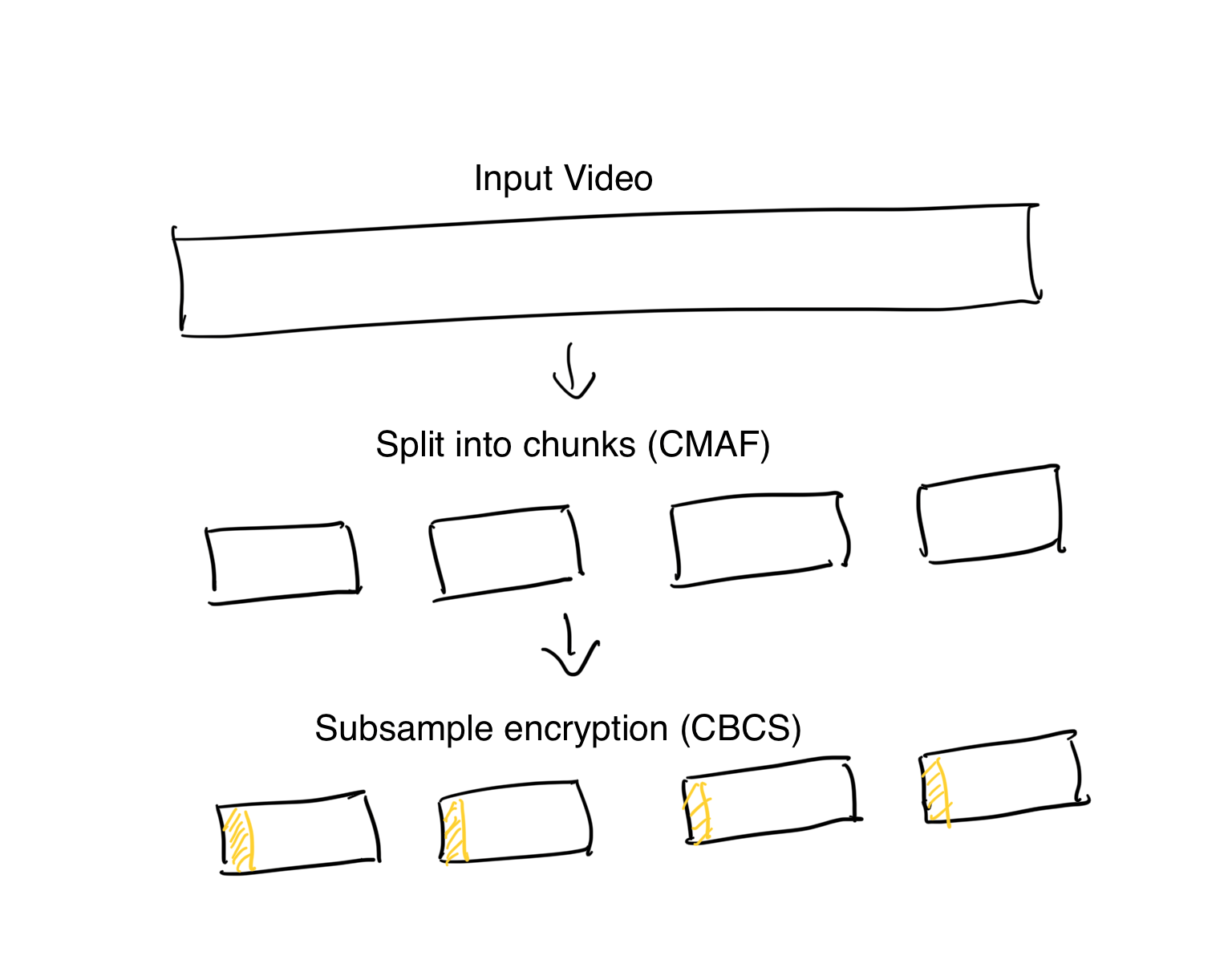
Only two of these protection schemes are relevant and being used for video and audio:
cenc and cbcs. They are defined in confusingly similar named CENC (Common Encryption Standard ).
Apple Fairplay and Google Widevine (the DRM systems for Apple and Google ecosystems) both support cbcs. Google Widevine also supports cenc but since Fairplay does not support it, most content providers have now switched to using cbcs.
CBCS
CBCS is an encryption method where the main encryption technology is CBC-AES128 (Cipher Block Chaining ). It’s symmetric encryption where fixed KEY and IV are required for both encryption and decryption. CBCS is a subsample encryption method which means only part of the video is encrypted. Wait WHAT? Yes, you read it correctly. The video is divided into 4 or 8-second chunks and only the first few bytes (typically 10% of the chunk) of the chunk are actually encrypted. The rest of the bytes are the same as before. This seems like a major lapse but it’s not. If those first bytes can’t be read, the rest of the chunk can’t be read. This is because the video itself is encoded using AVC or HEVC. The advantage of subsample encryption is that encryption and decryption are extremely fast and consume a lot less CPU resources (around 10% of resources compared to encrypting an entire file).